Chromatographic Separation and Analytical Detection: Advanced Techniques for Molecular Identification
Introduction to Chromatographic Separation
The analysis of complex chemical and biological mixtures requires reliable methodologies capable of separating individual components and detecting their presence with high analytical precision. Chromatographic separation and analytical detection represent essential approaches in modern analytical chemistry, biochemical research, pharmaceutical development, and biotechnology.
Chromatography is based on the differential distribution of compounds between a stationary phase and a mobile phase. As a sample moves through a chromatographic system, its constituents interact differently with these phases, resulting in distinct migration rates and separation profiles.
The resulting chromatographic signals provide valuable information about sample composition, molecular characteristics, and the relative abundance of individual constituents.
By combining separation principles with advanced detection technologies, chromatographic methodologies support the investigation of complex samples across numerous scientific disciplines.


Fundamental Principles of Chromatographic Separation
Chromatographic separation depends on differences in the physicochemical interactions between sample components and the chromatographic phases.
The stationary phase remains fixed within the separation system, while the mobile phase transports the sample through the analytical environment.
Compounds exhibiting stronger interactions with the stationary phase generally migrate more slowly, whereas compounds with greater affinity for the mobile phase may move more rapidly.
Several factors influence chromatographic performance:
Chemical polarity of the analytes.
Molecular size and structural characteristics.
Composition of the mobile phase.
Properties of the stationary phase.
Flow rate and temperature.
Column dimensions and particle characteristics.
Interactions between analytes and chromatographic surfaces.
The optimization of these parameters is essential for achieving appropriate separation efficiency, reproducibility, and analytical resolution.
Major Chromatographic Techniques
Different chromatographic techniques are available depending on the nature of the sample, the chemical properties of the analytes, and the analytical objectives.
High-Performance Liquid Chromatography (HPLC)
High-performance liquid chromatography uses a liquid mobile phase and a packed stationary-phase column to separate compounds according to their interactions with the chromatographic system.
HPLC is widely applied in pharmaceutical analysis, biochemical investigations, food chemistry, and the characterization of complex molecular mixtures.
Common applications include:
Quantification of pharmaceutical compounds.
Analysis of amino acids and peptides.
Separation of organic acids.
Characterization of plant extracts.
Detection of biochemical metabolites.
Evaluation of sample purity.
Reversed-phase HPLC is particularly common because it enables the separation of compounds according to their hydrophobic interactions with nonpolar stationary phases.
Gas Chromatography (GC)
Gas chromatography is primarily used for compounds that can be vaporized without significant thermal decomposition.
The mobile phase consists of an inert carrier gas, while separation occurs within a column containing a stationary phase.
GC is particularly useful for analyzing volatile and semi-volatile compounds.
Applications include:
Essential oil characterization.
Volatile organic compound analysis.
Environmental contaminant monitoring.
Residual solvent determination.
Chemical composition profiling.
Analysis of complex organic mixtures.
The combination of gas chromatography with mass spectrometry (GC-MS) provides additional structural information that supports compound identification.
Thin-Layer Chromatography (TLC)
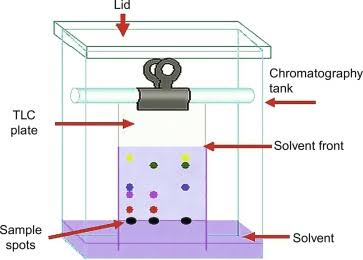
Thin-layer chromatography is a practical separation technique in which compounds migrate across a thin stationary layer deposited on a supporting surface.
The separation process depends on differences in adsorption and partitioning between the stationary and mobile phases.
TLC is frequently used for preliminary sample screening, reaction monitoring, and qualitative comparison of chemical mixtures.
Retention factor (Rf) values can be calculated to describe the migration of individual compounds relative to the solvent front.
Ion-Exchange Chromatography
Ion-exchange chromatography separates molecules according to differences in their electrical charge and interactions with charged stationary-phase groups.
It is particularly useful for investigating proteins, peptides, nucleic acids, and other charged biological molecules.
Separation can be influenced by parameters such as pH, ionic strength, and mobile-phase composition.
Size-Exclusion Chromatography
Size-exclusion chromatography separates molecules according to their hydrodynamic size.
The stationary phase contains porous particles that influence the migration of molecules depending on their ability to enter these pores.
Larger molecules generally elute earlier because they have limited access to the internal pore volume, while smaller molecules enter more pores and therefore exhibit longer retention times.
This technique is commonly applied to polymer characterization, protein analysis, and molecular-size distribution studies.
Analytical Detection Systems
Chromatographic separation alone does not provide complete information about the identity and quantity of separated compounds. Detection systems are therefore integrated into chromatographic instruments to generate measurable analytical signals.
The selection of a detector depends on the chemical characteristics of the analytes and the sensitivity requirements of the analytical method.
Ultraviolet-Visible Detection
UV-Visible detectors measure the absorption of ultraviolet or visible radiation by compounds containing suitable chromophores.
They are widely used in HPLC for the quantification of pharmaceutical compounds, aromatic molecules, proteins, and other absorbing substances.
Diode-array detection (DAD) can additionally provide spectral information across multiple wavelengths, facilitating the comparison of chromatographic peaks.
Fluorescence Detection
Fluorescence detectors measure light emitted by compounds following excitation at specific wavelengths.
This technique can offer high sensitivity and selectivity for naturally fluorescent molecules or compounds modified with fluorescent labels.
Applications include the analysis of amino acids, proteins, vitamins, and selected biochemical metabolites.
Mass Spectrometric Detection
Mass spectrometry provides information about the mass-to-charge ratios of ions generated from analytes.
When coupled with chromatography, mass spectrometry combines efficient separation with molecular characterization.
LC-MS and GC-MS systems are particularly valuable for identifying compounds in complex samples.
Tandem mass spectrometry (MS/MS) provides additional structural information through the fragmentation of selected precursor ions.
Refractive Index Detection
Refractive index detectors measure differences in refractive index between the mobile phase and the sample-containing eluent.
They are commonly used for compounds that do not exhibit significant ultraviolet absorption, including certain sugars and polymers.
Electrochemical Detection
Electrochemical detectors measure electrical responses associated with oxidation or reduction processes occurring at an electrode surface.
They can provide sensitive detection for electroactive compounds, including selected neurotransmitters and biochemical molecules.

Chromatographic Parameters and Separation Efficiency
Evaluating chromatographic performance requires the interpretation of several quantitative parameters.
These measurements help determine whether an analytical method provides adequate separation and reproducible results.
Retention time (tR)
Retention time represents the period required for an analyte to travel through the chromatographic system and reach the detector.
Retention factor (k)
The retention factor describes the retention of an analyte relative to the mobile-phase hold-up time.
Resolution (Rs)
Resolution measures the degree of separation between two adjacent chromatographic peaks. Higher resolution generally indicates more effective separation.
Theoretical plate number (N)
The theoretical plate number is an indicator of column efficiency. Higher values generally correspond to narrower peaks under comparable conditions.
Peak symmetry
Peak symmetry describes the shape of chromatographic signals. Significant tailing or fronting can affect integration and quantitative reliability.
Limit of detection (LOD) and limit of quantification (LOQ)
LOD represents the lowest analyte level that can be reliably distinguished from background noise, while LOQ represents the lowest level that can be quantified with suitable analytical performance.
These parameters contribute to the systematic evaluation and optimization of chromatographic methods.
Method Development and Analytical Optimization
Developing a reliable chromatographic method requires systematic evaluation of the experimental conditions influencing separation and detection.
The analytical process generally begins with an understanding of the sample composition and the physicochemical properties of the target compounds.
Important development stages include:
Sample preparation: Selecting appropriate extraction, filtration, dilution, and cleanup procedures.
Stationary-phase selection: Choosing a column chemistry compatible with the analytes.
Mobile-phase optimization: Adjusting solvent composition, pH, ionic strength, and gradient conditions when applicable.
Instrumental parameter adjustment: Optimizing flow rate, temperature, injection volume, and detector settings.
Separation evaluation: Examining retention times, peak resolution, efficiency, and signal quality.
Method validation: Evaluating accuracy, precision, selectivity, linearity, sensitivity, and robustness.
Systematic optimization helps establish analytical procedures that are suitable for their intended applications.

Applications in Biotechnology and Pharmaceutical Research
Chromatographic separation and analytical detection contribute to numerous areas of scientific investigation.
Biochemical Research
Chromatographic methods facilitate the separation and characterization of proteins, peptides, amino acids, metabolites, and other biochemical constituents.
Pharmaceutical Analysis
HPLC and LC-MS are widely used to investigate active pharmaceutical ingredients, impurities, degradation products, and formulation composition.
Natural Product Characterization
GC-MS and HPLC support the chemical profiling of essential oils, plant extracts, and naturally occurring compounds.
Proteomics
Liquid chromatography coupled with tandem mass spectrometry is an important analytical approach for separating peptides and supporting large-scale protein identification.
Environmental Analysis
Chromatographic methods are applied to the detection and quantification of environmental contaminants, including pesticides, organic pollutants, and selected industrial compounds.
Metabolomics
Chromatographic platforms combined with mass spectrometry enable the investigation of complex metabolite profiles and changes in biochemical composition.
Quality Control and Analytical Reliability
The reliability of chromatographic results depends on the consistent performance of the analytical system and the appropriate control of experimental variables.
Quality control procedures may include:
Instrument calibration and performance monitoring.
Evaluation of reference standards.
Assessment of system suitability.
Monitoring of retention-time stability.
Verification of detector response.
Replicate measurements.
Documentation of analytical procedures.
Evaluation of method precision and accuracy.
In regulated pharmaceutical environments, analytical methods may also require validation according to applicable regulatory and quality standards.
Emerging Developments in Chromatographic Technologies
Technological advances continue to improve chromatographic separation, detection sensitivity, and analytical data processing.
Several developments are particularly relevant to modern analytical research.
Ultra-High-Performance Liquid Chromatography (UHPLC)
UHPLC uses columns containing smaller stationary-phase particles and operates at higher pressures, allowing improved separation efficiency and reduced analysis times in suitable applications.
Hyphenated Analytical Techniques
The combination of chromatographic systems with mass spectrometry and other analytical detectors provides complementary information about sample composition and molecular structure.
Miniaturized Chromatographic Systems
Developments in microfluidics and miniaturized separation platforms are contributing to more compact analytical systems and reduced sample requirements.
Automated Data Processing
Advanced software tools facilitate chromatographic peak integration, compound identification, signal evaluation, and quantitative analysis.
Artificial Intelligence in Analytical Chemistry
Machine learning approaches are increasingly being investigated for chromatographic data interpretation, peak recognition, anomaly detection, and analytical method optimization.

Chromatographic separation and analytical detection constitute essential components of modern analytical science. By combining physicochemical separation principles with sensitive detection technologies, these methods enable the investigation of complex chemical and biological samples.
From HPLC and gas chromatography to mass spectrometry and fluorescence detection, each analytical approach offers specific advantages depending on the characteristics of the compounds under investigation.
Continuous improvements in column technologies, instrumental sensitivity, automated data processing, and computational analysis are expanding the possibilities of chromatographic research across biotechnology, pharmaceutical science, biochemistry, and environmental analysis.
A comprehensive understanding of chromatographic principles and analytical performance parameters remains fundamental to developing reliable, reproducible, and scientifically meaningful analytical methods.